AI Won't Steal Your Job – But It Will Change Everything: A Realistic Look at Automation's Impact
Is AI Coming for Our Jobs?
Artificial intelligence is unlikely to produce permanent mass unemployment, but without class struggle from below and state action, automation will deepen inequality and leave workers to bear its costs.
How Technology Changes Work
Automation comes in two forms: replacing entire workers (like spinners in the 19th century) or replacing specific tasks (like electric drills replacing manual drilling). Both increase productivity—meaning more output with the same labor—but only the first type directly eliminates jobs.
AI builds on what computers already do: handling easily defined, replicable tasks with clear rules (think spreadsheets, accounting). So far, AI's labor market effects have been small and resemble previous technological waves rather than representing something radically new.
Job transformation vs. job elimination: When ATMs were introduced, bank teller jobs didn't disappear—they transformed from simple clerks to customer relations roles. Similarly, automation often changes job content rather than eliminating positions entirely.
Technical Change, Linkages, and Unemployment
The economy isn't a zero-sum game: While automation displaces workers in specific sectors, it also increases productivity and economic growth, creating demand for labor elsewhere. Karl Marx noted this dual process: technical change displaces labor while simultaneously accelerating economic growth that absorbs displaced workers.
Linkage effects matter: When automation happens in capital goods industries (machines, raw materials), it lowers input prices for downstream industries, making production more profitable and creating more jobs.
Historical perspective: Waves of technological change (textiles automation, steam power, electricity) have never caused long-term unemployment increases. The unemployment rate has remained relatively constant throughout capitalism's history.
Automation and Profitability
Technology's impact on work experience is indeterminate: Some innovations make work easier (cranes replacing backbreaking labor), while others make it worse (assembly lines increasing pace and reducing creativity).
Profit motive drives implementation: Capitalists introduce technology to lower costs and beat competitors, not to improve workers' lives. Any benefits to workers are incidental byproducts.
Seizing the Means of Prediction
Job loss is traumatic but manageable: The solution isn't blocking technological change but creating social safety nets: generous unemployment insurance, ambitious retraining programs, and a robust welfare state to share automation's costs across society.
Socialism's promise: Harnessing productivity increases to reduce work time while making work more meaningful and democratic. The goal should be human flourishing through reduced toil and increased free time.
Technology and Income Inequality
The productivity-wage gap: Since the 1970s, productivity has continued rising while wages have stagnated—a break from historical patterns where they moved in tandem.
Political mediation matters: This divergence correlates with the decline of trade unions and increased globalization, which reduced workers' bargaining power. How automation's benefits are distributed depends on class power dynamics.
Labor's current weakness: Today's tech industries have enormous power while labor has little, making it difficult to ensure AI's benefits flow to workers rather than just enriching tech executives.
Looking Past the AI Hype
AI's actual capabilities: So far, AI handles explicit knowledge (clear rules) but struggles with tacit knowledge (judgment, creativity, instinct)—the truly human elements of work. Most current applications either displace low-end tasks or serve as tools within existing occupations.
Hype vs. reality: Much AI excitement comes from companies selling products. Actual returns have been modest, with capabilities leveling off rather than growing exponentially.
The real challenge: Regardless of AI's ultimate capabilities, its effects will benefit those with social power. The focus should be on organizing labor and building institutions to ensure technological change serves the general good.
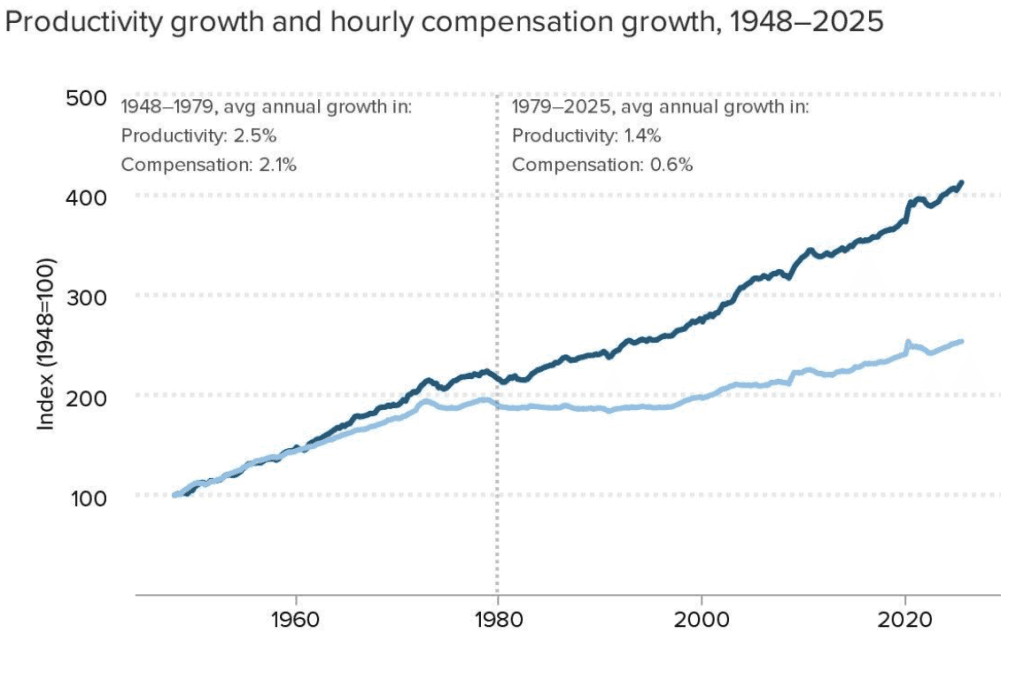
Source: Economic Policy Institute
- #ai
- #automation
- #jobsecurity
- #futureofwork
- #productivity
Comments · 0