Canada's Job Market Mystery: Why Payrolls Are Falling While Job Vacancies Rise

Conflicting Labor Market Reports
Canadian payroll employment fell in September even as job postings ticked up for the first time since early 2024, new Statistics Canada data show, underscoring an uneven labour market that economists say looks weaker in payrolls than in headline job numbers.
The number of employees receiving pay and benefits from an employer declined by 58,000, or 0.3 per cent, in September, erasing the combined gain of 43,200 (+0.2 per cent) recorded over July and August.
On a year-over-year basis, payroll employment was little changed.
Economists Compare Payroll Survey to Household Data
The latest release from the Survey of Employment, Payrolls and Hours (SEPH) stands in contrast to the picture painted by Statistics Canada’s Labour Force Survey (LFS), a household-based measure that has recently shown stronger employment growth.
“Call it a tale of two employment reports,” David Rosenberg, president of Rosenberg Research & Associates said in the Financial Post. “If you pay attention to the notoriously volatile Canadian household survey, you could be forgiven for thinking that the local economy is in the midst of a surprising boom.”
Other economists have described the LFS as volatile and not wholly reliable on a month-to-month basis, preferring to focus on three‑month trends. Rosenberg, however, puts more weight on the payroll-based data.
“Payroll is payroll,” he said in the article. “A survey of households is prone to a wide error term.”
Katherine Judge, economist at CIBC Capital Markets, said the SEPH results depict a softer backdrop than the household survey.
“The SEPH presents the labour market in a different light,” she said in the Financial Post. “The payroll survey of employment continued to paint a weaker picture of Canada’s labour market relative to the LFS. That leaves employment flat versus year-ago levels, relative to the comparable LFS measure that showed a 1.7 per cent year-over-year increase in the last release.”
Since 2022, growth in SEPH payroll counts has slowed steadily. Payroll employment rose 5.5 per cent year over year three years ago, two per cent two years ago and one per cent last year.
“The trend in the series continues to suggest a weak labour market,” Judge said in the article.
Broad Sector Declines Led by Education, Manufacturing and Real Estate
Payroll counts dropped in 11 of 20 sectors, says Statistics Canada.
Educational services saw the largest setback, with payroll employment down 19,100 (-1.3 per cent) in September, wiping out the cumulative increase of 18,100 (+1.2 per cent) over July and August. Compared with September 2024, payroll employment in educational services declined by 17,500 (-1.2 per cent), with losses concentrated in community colleges and CEGEPs (-13,000; -9.1 per cent).
In manufacturing, payroll employment decreased by 9,600 (-0.6 per cent) in September. The pullback was widespread, with 16 of 21 subsectors posting declines. From January to September 2025, manufacturing payrolls fell by 36,500 (-2.3 per cent), with 19 of 21 subsectors registering drops. Transportation equipment manufacturing (-7,500; -3.7 per cent), food manufacturing (-4,600; -1.7 per cent) and chemical manufacturing (-3,800; -3.9 per cent) accounted for some of the largest declines over that period.
Professional, scientific and technical services lost 6,400 (-0.5 per cent) payroll positions in September, the second consecutive monthly decline. Taken together, August and September saw a cumulative reduction of 12,000 (-1.0 per cent), following an increase in July and relatively modest net changes in the first half of 2025. Recent losses were led by management, scientific and technical consulting services (-6,800; -5.5 per cent) and computer systems design and related services (-2,800; -0.7 per cent).
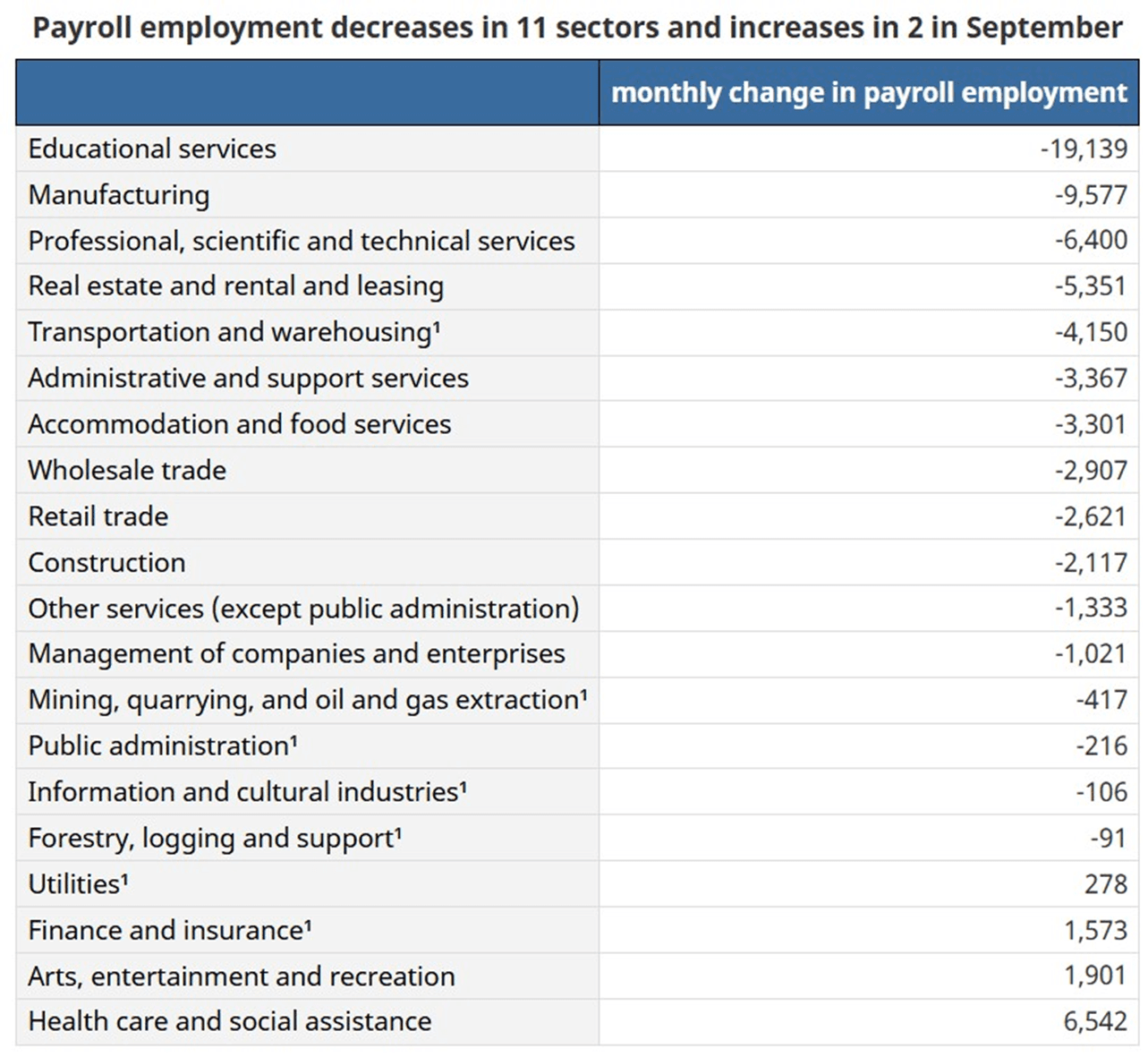
In real estate and rental and leasing, payroll employment fell by 5,400 (-1.8 per cent) in September, the steepest monthly drop in the sector since May 2021. Compared with a year earlier, payroll employment in the sector was down 3,400 (-1.2 per cent), led by offices of real estate agents and brokers (-1,600; -4.7 per cent) and lessors of real estate (-1,200; -1.0 per cent).
Health care and social assistance (+6,500; +0.3 per cent) and arts, entertainment and recreation (+1,900; +0.6 per cent) were the only sectors to record payroll employment gains in September.
The reshaping of employment is occurring against a backdrop in which public sector hiring has far outpaced private-sector job creation over the last decade. A recent report from the Fraser Institute found that the public sector added 950,000 jobs between 2015 and 2024.
Job Vacancies Rise for First Time Since Early 2024
Alongside the drop in payrolls, job postings climbed in September, says StatCan.
Job vacancies increased to 486,000 (+25,500; +5.5 per cent), the first month‑to‑month increase since January 2024. Over 12 months, however, vacancies were still down 49,700 (-9.3 per cent). The national job vacancy rate rose to 2.7 per cent from 2.6 per cent in August, remaining below the 3.0 per cent recorded in September 2024.
There were 3.3 unemployed persons for every job vacancy in September, down from 3.5 in August. Compared with a year earlier, the unemployment‑to‑job‑vacancy ratio was up 0.6.
Vacancy levels increased in four sectors: construction (+5,100; +14.9 per cent), manufacturing (+3,400; +10.8 per cent), information and cultural industries (+1,500; +24.8 per cent) and management of companies and enterprises (+600; +42.1 per cent).
Year over year, job vacancies fell in 9 of 20 sectors, led by health care and social assistance (-16,200; -14.1 per cent), transportation and warehousing (-5,700; -19.7 per cent) and other services (except public administration) (-5,300; -19.5 per cent).
Statistics Canada said job vacancies rose slightly, but the number of unemployed people per opening remained at 3.3.
- #canada
- #jobmarket
- #employment
- #economy
- #statistics
Comments · 0