India's Rural Jobs Revolution: How a Landmark Scheme Faces Major Overhaul
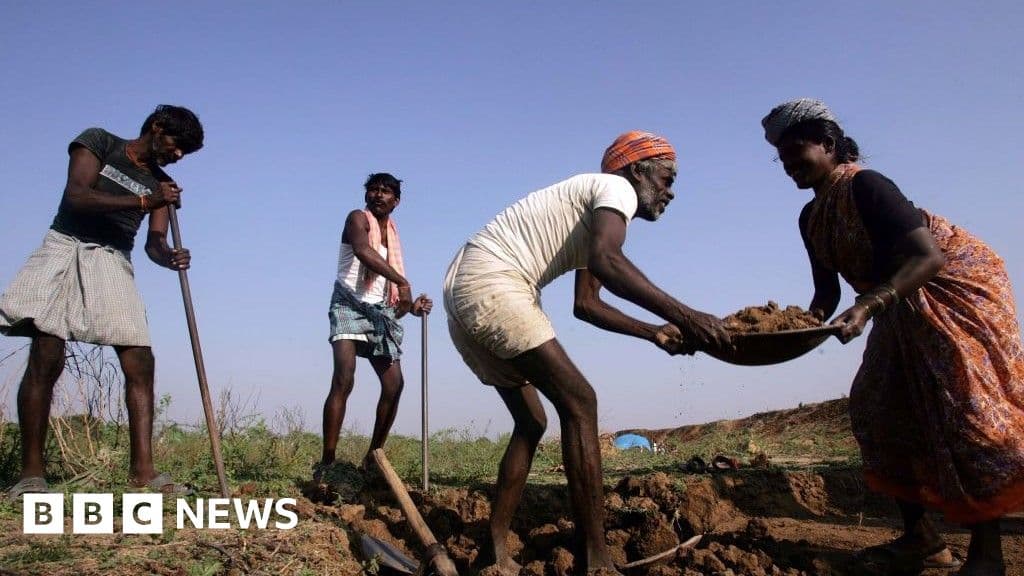
India's Rural Employment Guarantee: A Global Model Under Threat?
India is home to one of the world's most ambitious social programs - a rural jobs guarantee that gives every rural household the legal right to paid work. Launched in 2005 as the National Rural Employment Guarantee Scheme (NREGS), it provided every rural household with a legal right to demand up to 100 days of paid manual work each year at a statutory minimum wage.
 Providing unskilled public work, the jobs scheme has become a backbone of rural livelihoods in India
Why This Matters for Rural India
This program matters profoundly in a country where 65% of 1.4 billion people live in rural areas and nearly half rely on farming, which generates insufficient income. The scheme has become a backbone of rural livelihoods, cushioning demand during economic shocks and serving as one of the world's most studied anti-poverty programs.
Key achievements include:
- Over half of the estimated 126 million scheme workers are women
- Around 40% come from "scheduled castes" or tribes, among the most deprived Indians
- Economists credit the scheme with lifting rural consumption, reducing poverty, improving school attendance, and pushing up private-sector wages in some regions
The Controversial New Law: G RAM G
Last week, the government introduced a new law that repeals and rebrands the scheme. While the program was renamed MGNREGA in 2009 to honour Mahatma Gandhi, it has now dropped his name altogether.
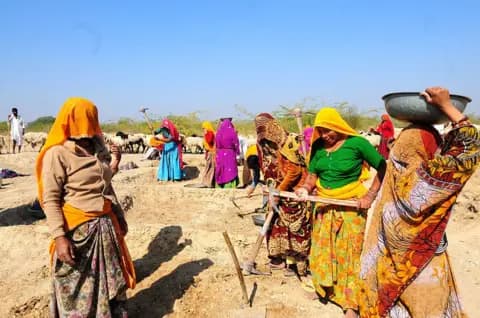 Women at work under the scheme in Rajasthan; they make up over half of all workers
What the new G RAM G law actually changes:
- Raises the annual employment guarantee from 100 to 125 days per rural household
- Retains the provision that workers not given jobs within 15 days are entitled to an unemployment allowance
- Shifts funding from a 90:10 federal-state split to a 60:40 split, potentially pushing states' contribution to 40% or more of total project cost
- The federal government keeps control, including the power to notify the scheme and decide state-wise allocations
The government frames these reforms as a modernized, more effective, and corruption-free program aimed at empowering the poor. Federal agriculture minister Shivraj Singh Chouhan states: "This law stands firmly in favour of the poor, in support of progress, and in complete guarantee of employment for the workers."
Critics Sound the Alarm
Critics - including opposition parties, academics, and some state governments - warn that capping funds and shifting costs to states could dilute a rare legal right in India's welfare system.
Development economist Jean Dreze argues: "It is the culmination of the long-standing drive for centralization of the scheme under the Modi government. But it is more than centralization. It is the reduction of employment guarantee to a discretionary scheme."
Key concerns include:
- The increase to 125 days may be a "red herring" - only 7% of rural households received the full 100 days guaranteed under the original scheme in 2023-24
- Financial restrictions may undermine the raised ceiling
- A group of international scholars has petitioned the government, warning that the new funding model could undermine the scheme's purpose
Measuring the Scheme's Impact
Despite persistent challenges including underfunding and delays in wage payments, the scheme has delivered measurable impact. An influential study found that the broader, economy-wide impacts of the scheme boosted beneficiary households' earnings by 14% and cut poverty by 26%.
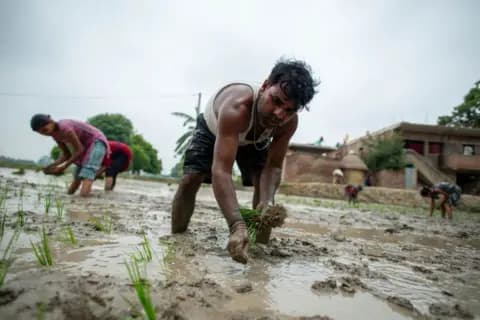 Nearly half of Indians depend on agriculture for largely low-paying livelihoods
However, the scheme's durability also underscores a deeper structural problem: India's chronic inability to generate enough non-farm jobs to absorb surplus rural labor. Agriculture has consistently lagged behind the broader economy, growing just 3% annually since 2001–02, compared with 7% for the rest of the economy.
The Bigger Picture: India's Employment Crisis
Recent research suggests that India's rise in labor force participation, especially among women, reflects economic distress rather than growth-driven job creation. The increase is concentrated in the most vulnerable forms of work: unpaid family helpers and self-employed workers, who have very low productivity and falling real earnings.
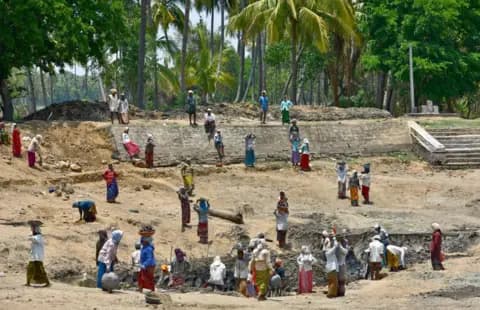 Villagers work on reviving a lake under the scheme in Andhra Pradesh
This evidence suggests people are driven into subsistence work by necessity, not drawn into better-quality jobs by a stronger economy. This ensures that the world's largest jobs guarantee scheme will remain central to the livelihoods of hundreds of millions of Indians - whether the revamped version will strengthen it or undermine its impact remains to be seen.
- #ruralemployment
- #india
- #jobguarantee
- #economicpolicy
- #socialsecurity
Comments · 0